Fired Because of AI, Hired to Clean Up After It
Last week I was approving new listings on my job board when I stopped on one posting and read it three times. It was a senior Node.js role from a mid-sized US company. Nothing unusual about the stack.
Sam Altman, the CEO of OpenAI, the person who spent the last three years telling the world that AI would eliminate entire categories of white-collar work, stood in front of an audience at a banking conference in Sydney and said something nobody expected: he was wrong.
A developer from Eastern Europe emailed me last week. She had been about to apply to a job posting titled Junior Frontend Developer. The salary was modest, maybe one third of what a senior London or Berlin offer would pay.
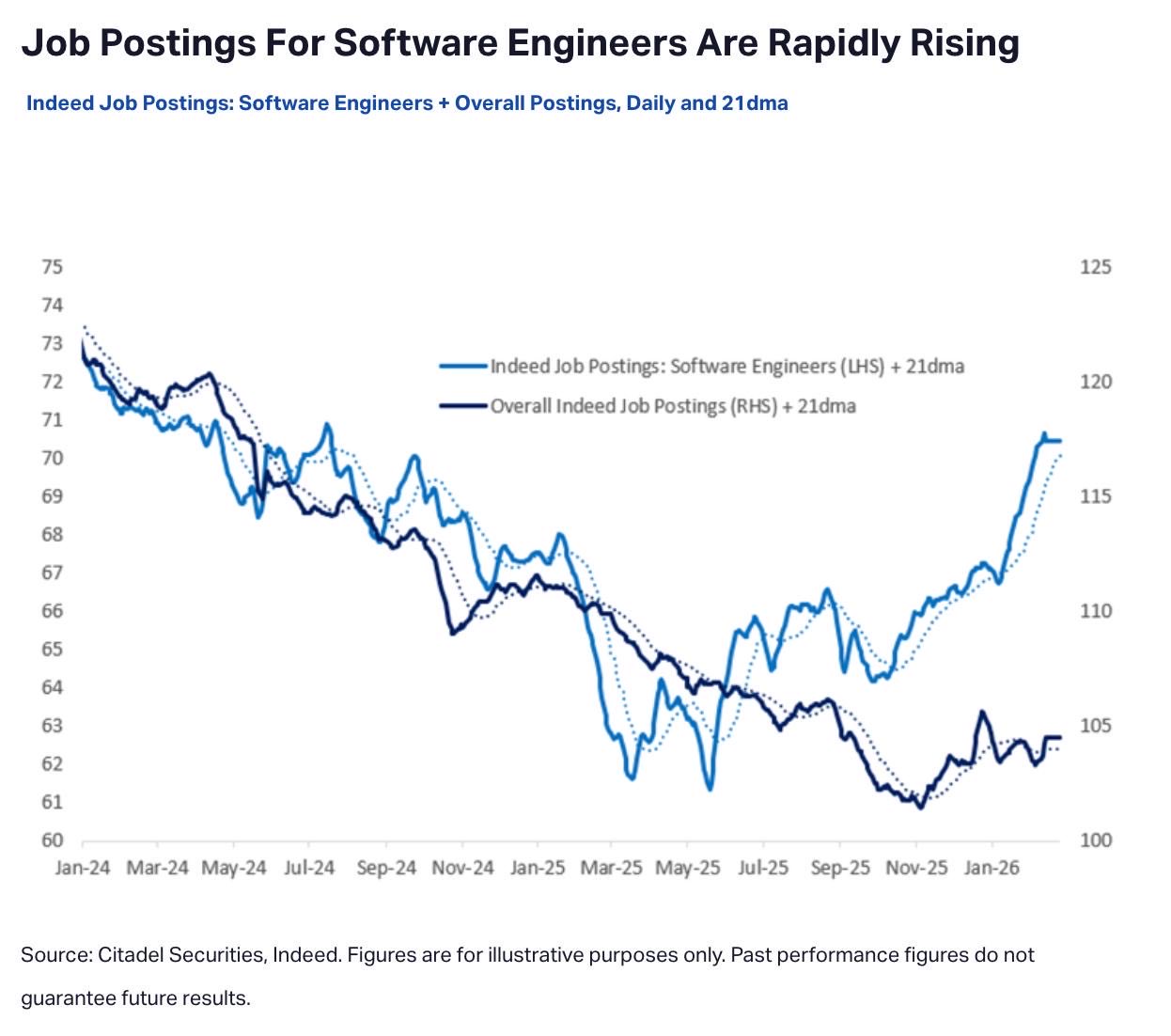
JavaScript developer reading a viral Indeed and Citadel Securities chart showing software engineer job postings rising in 2026 while frustrated developers in the LinkedIn comments explain why the chart does not match their actual job search experience
Last Tuesday I was reviewing a job posting on jsgurujobs.com from a US-based fintech. Senior frontend engineer. React, TypeScript, Next.js, Tailwind. Salary disclosed at $180K to $220K. Standard senior frontend stack and a real salary range. The kind of posting I would normally approve in two minutes.
It is 3 AM. A senior engineer at a Series B startup is staring at a codebase that does not work anymore. Three months ago this system shipped features twice as fast as competitors. The team used Claude Code aggressively.
I checked my job board this morning before writing this. Of the 430 active JavaScript listings, I counted the ones explicitly looking for junior or entry-level developers. There were nine. Less than three percent. A year ago that number was around twenty-five. Two years ago it was closer to sixty.
A developer messaged me three weeks ago. He had found a senior React position through my board, went through four rounds of interviews, got the offer, and started working. Everything looked right. The company was real. The salary was good. The tech stack matched the posting. He was excited.
Two weeks ago I opened my job board at 7 AM with my coffee and counted the new remote JavaScript postings that came in overnight. Twenty three of them said "remote" in the title. I went through each one, line by line, looking for the fine print. Here is what I found.
Last Tuesday I was doing my daily review of new postings on jsgurujobs.com and I caught myself doing something I had been doing for weeks without noticing. I was skipping past the first half of almost every job description to find the actual requirements.
A senior React developer with 8 years of experience walked into his manager's office in March 2026 and quit. No new job lined up. No startup he was joining. No grand plan to launch a product or move to another country.
I have reviewed hundreds of messages from JavaScript developers on LinkedIn this year. The pattern that stands out most is not their technical skills. It is their inability to describe what they do in a way that makes someone want to hear more.
If I could rewrite every template message I have received into one message that represents the perfect outreach, it would look like this:
Every JavaScript developer learns how to write code. Nobody teaches how to read it. This is a problem because reading code is 80% of the job. A senior developer at any company spends most of their day reading pull requests, navigating unfamiliar modules, tracing data flow through components, and understanding code written by people who left the company two years ago.
I analyzed every job posting on jsgurujobs.com this week. Not a survey. Not a sample. Every single one of the 415 active JavaScript job listings in our database, scraped from company career pages, parsed for technologies, salaries, locations, and requirements. The results contradict most of the career advice you see on Twitter.
The developer who got promoted to senior at my last company did not write the best code. He was not the fastest. He did not know the most frameworks. He got promoted because when a product manager asked "how long will this take?"
A developer with no computer science degree, no Big Tech experience, and no professional references got hired as a senior engineer at a well-funded startup last month. His resume was thin. His interview was average.
Six hundred applications. That's the number one recruiter posted on X in March 2026 after opening a single JavaScript developer position at a mid-size startup. The role had been live for 72 hours. The company was offering $130K, remote-friendly, interesting product. And 600 people had already applied.
LinkedIn just named AI Engineer the fastest-growing job title of 2026. Not prompt engineer. Not ML researcher. AI Engineer. The role that sits exactly at the intersection of software development and artificial intelligence, the one that JavaScript developers are uniquely positioned to fill, and the one that's currently paying $150K to $200K at companies that were offering $90K for senior React developers eighteen months ago.
A post went viral on March 10, 2026. An 18-year senior software developer, someone who had shipped production systems before most of today's junior developers were in high school, was working at McDonald's.
Entry-level tech job postings dropped 73% in one year. Block fired 40% of its engineers. Amazon replaced 2,847 Prime Video developers with AI and offshore teams. Oracle is planning 20,000 to 30,000 cuts to fund AI data centers. Every headline in March 2026 says the same thing: AI is killing developer jobs, starting with the juniors.
A computer science graduate from Carnegie Mellon applied to 1,200 entry-level developer positions in 2026. Zero offers. He is now applying to Starbucks. This is not a random failure.
A survey published in the first week of March 2026 found that 55% of hiring managers in the United States expect their companies to conduct layoffs this year. Of those, 44% pointed directly at AI as the primary driver. Not budget cuts. Not recession fears. AI.
A developer named Marcus shipped a complete SaaS product in February 2026. User authentication, Stripe payment processing, a real time dashboard, an admin panel, email notifications, a landing page with SEO optimization, and automated deployment to production. The entire application handles paying customers, processes real money, and runs without a dedicated ops team.
Three years ago, I got promoted to mid-level developer. I felt like I had made it. Good salary. Interesting projects. Respect from colleagues who used to review my code and now asked for my opinions.

Reading through those applications was brutal. Hundreds of qualified developers, all wanting the same thing: a remote position that lets them work from anywhere while earning competitive compensation. Most of them would never hear back. Not because they were bad developers, but because there is no way to meaningfully evaluate 847 people.
Last week Amazon announced 16,000 corporate layoffs. This was their second wave in three months, bringing total cuts to roughly 10 percent of their corporate workforce. The same week, Intel confirmed 24,000 job cuts, representing 20 percent of their entire staff. Meta added another 1,500 to the pile, explicitly citing their pivot to AI as the reason.
The email arrived at 9:47 AM on a Tuesday. It was from HR, not my manager, and the subject line was simply "Meeting Request." I knew what it meant before I even opened it. Twenty minutes later, I was sitting in a conference room listening to words that felt like they were coming from underwater. "Position eliminated." "Business restructuring." "Not a reflection of your performance."

Every JavaScript developer faces this decision at some point. You have built up your skills in React, Node.js, TypeScript, and modern frameworks. You have shipped products and solved real problems. Now comes the question that keeps appearing in every career conversation, every salary negotiation, and every late night scroll through job boards.
A senior developer at a Fortune 500 company recently shared his story on a programming forum. He was 31 years old with a decade of experience, great performance reviews, and a salary most would envy. And he was about to quit programming entirely. Not because he couldn't code anymore. Not because the industry changed. Not because the money wasn't good enough.
The gap between freelance JavaScript developers earning $50 per hour and those commanding $200 per hour rarely reflects technical skill differences alone. Developers at both ends of this spectrum often possess similar coding abilities, know the same frameworks, and deliver comparable quality work. The dramatic rate difference comes from positioning, client selection, pricing psychology, and systematic business practices that separate hobbyist freelancers from professional consultants.
Most JavaScript developers leave tens of thousands of dollars on the table by accepting first offers without negotiation. The reluctance to negotiate stems from discomfort with confrontation, fear of losing the offer, or simply not knowing how to approach the conversation. However, companies expect negotiation and build flexibility into initial offers specifically to accommodate counter-offers. The developer who accepts immediately signals either desperation or lack of market awareness.
The engineering manager role represents one of the most misunderstood career transitions in technology. Most senior developers imagine management as their current job plus some meetings and performance reviews. This fundamental misconception leads to painful surprises when talented engineers accept management positions and discover they've entered an entirely different profession.
When I first heard about the Staff Engineer position at a friend's company, I assumed it was just a fancy title for a senior developer who'd been around longer. I was completely wrong. Six months into my Staff role, I realized I'd fundamentally misunderstood what this position actually entails and why companies suddenly started creating these roles everywhere.

I spent three years stuck at the mid-level developer plateau earning $95,000 while watching colleagues with similar technical skills jump to $180,000 senior positions. The frustration of being passed over for promotions while delivering solid code pushed me to figure out what I was missing. The answer wasn't what I expected.
The global developer shortage that companies hoped would resolve through economic corrections and layoffs instead intensified dramatically in 2026, creating a crisis 40% worse than 2025 according to multiple labor market analyses. The United States alone faces a 1.2 million software developer deficit by year end, while demand accelerates faster than new developers enter the workforce. Three converging forces created this perfect storm that's reshaping compensation and career trajectories: AI and machine learning expansion tripled demand for developers who can implement generative AI features and integrate language models into existing applications,
Stack Overflow's 2025 Developer Survey of 49,000 developers documents the tipping point where TypeScript transformed from optional enhancement to mandatory requirement. Sixty-nine percent of developers now use TypeScript for large-scale web applications, representing a 15% annual growth rate that shows no signs of slowing. The adoption data tells a more dramatic story when you examine who's actually hiring: 97% of developers recommend TypeScript according to the survey, and GitHub data reveals TypeScript overtook both Python and JavaScript as the number one language by contributor count in August 2025.
GitHub's Octoverse 2024 and 2025 reports document a historic shift that JavaScript developers need to understand correctly. Python briefly overtook JavaScript in late 2024 after a decade of JS dominance, driven by a 59% surge in AI and data science projects. But here's what the headlines miss: by August 2025, TypeScript, JavaScript's typed superset, reclaimed the number one position, surpassing both Python and JavaScript. This isn't JavaScript losing ground. This is JavaScript evolving and fragmenting its ecosystem in ways that make simple language rankings misleading. JavaScript still dominates code pushes, npm grew 15% year-over-year to over 2 million packages, and the combined JavaScript plus TypeScript ecosystem accounts for more total development activity than any other language family.
Geographic arbitrage isn't a travel hack, it's a wealth-building strategy that can accelerate your path to financial independence by seven to twelve years. Developers earning $120K in Silicon Valley salaries while living in Bali for $1,800 monthly are building wealth at rates that make traditional career advice look obsolete. Indonesia's new E33G Remote Worker Visa offers up to five years of tax-free living for foreign income earners, while Canggu has become the world's unofficial capital of digital nomadism with fiber optic internet and coworking spaces on every corner.
In 2025, developer salaries reflect a tech industry that’s no longer in hyper-growth but has entered a phase of maturity. This article breaks down real compensation numbers, remote salary trends, and how AI, inflation, and global hiring are reshaping what software developers earn — and what’s next for the job market.
Finding a remote JavaScript developer job in 2025 demands a strategic and thoughtful approach that goes beyond simply sending out a flurry of resumes. To boost your chances in an increasingly competitive landscape, it's crucial to focus on demonstrating your value to potential employers even before you formally apply.
Software developers command impressive technical expertise, yet many find their earnings fall short of their contributions. The tech industry’s rapid evolution offers practical strategies to boost income without sacrificing career fulfillment.
You no longer need perfect English to join an international team. Thanks to Google’s new real-time speech translation in Meet, language is no longer a barrier to working with global companies. Whether you're a senior JavaScript developer or just aiming to break into remote work, this breakthrough opens the door to international opportunities that were once out of reach.
Join 20000+ developers getting weekly JavaScript insights delivered to your inbox.