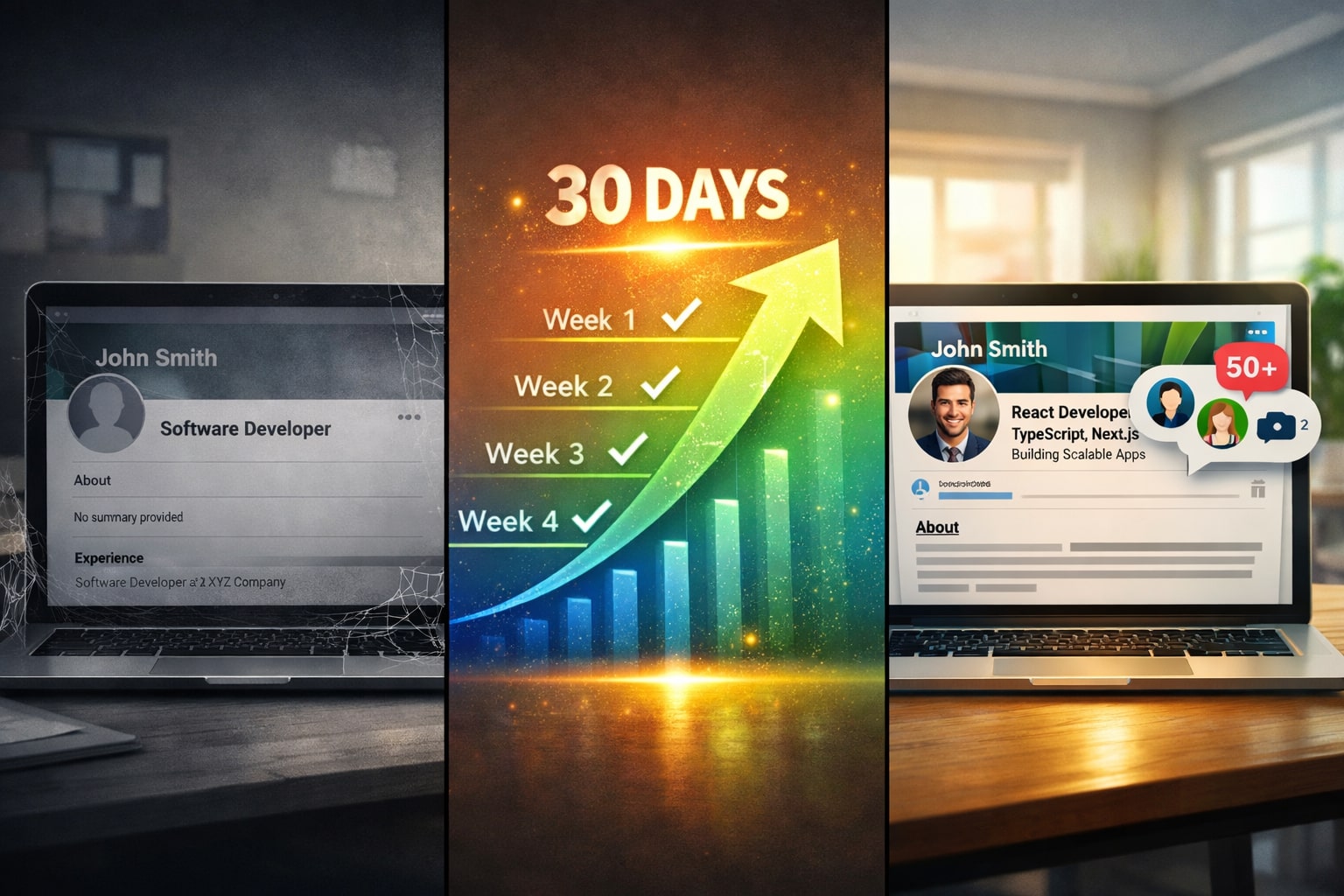
LinkedIn for JavaScript Developers 2026: The 30-Day System That Gets 50+ Recruiter Messages
📧 Subscribe to JS Pulse
The JavaScript job market in one email: real numbers from 600+ job listings, 5 jobs worth applying to, and what actually changed. Join 9,000+ developers.
Most JavaScript developers treat LinkedIn as an online resume they update once a year when job hunting. This passive approach misses the platform's primary value in 2026. LinkedIn functions as a search engine where recruiters and hiring managers actively look for candidates matching specific criteria. Your profile either appears in their searches or it doesn't. The difference between appearing consistently versus rarely determines whether you receive multiple messages weekly or crickets for months.
The gap between optimized and neglected LinkedIn profiles manifests dramatically in recruiter attention. Developers with strong profiles receive 50 to 100 inbound messages monthly from recruiters representing diverse opportunities. Those with weak profiles might see one or two messages over the same period, usually from spam recruiters mass messaging everyone. This disparity doesn't reflect skill differences but rather optimization differences that any developer can learn.
Building an effective LinkedIn presence requires systematic effort rather than sporadic updates when you remember the platform exists. Thirty days of focused optimization following a structured approach transforms average profiles into recruiter magnets. This timeline provides enough time to implement changes thoughtfully while maintaining momentum. The work investment pays dividends for years as inbound opportunities continue flowing long after the initial optimization effort.
Understanding How Recruiters Actually Use LinkedIn
Technical recruiters don't browse LinkedIn randomly hoping to stumble across great candidates. They use LinkedIn Recruiter, a premium tool that functions as a sophisticated search engine for finding people matching specific criteria. Understanding how these searches work helps you optimize your profile to appear in relevant results consistently.
Recruiter searches typically start with job title and location filters narrowing the pool to potentially relevant candidates. A recruiter looking for React developers might search for profiles with "React Developer," "Frontend Developer," or "JavaScript Developer" in their titles within specific geographic regions or marking themselves open to remote work. Profiles without these terms in titles won't appear regardless of actual experience.
Skills and keywords in your profile content determine ranking within search results. The search algorithm evaluates how well profiles match the query based on keyword frequency, recency of experience, completeness of profile information, and engagement signals. Two developers with similar experience rank differently based on how well their profiles are optimized for the search terms recruiters actually use.
Boolean search operators allow recruiters to create complex queries combining multiple criteria. They might search for profiles containing "React" AND "TypeScript" AND "Node.js" but NOT "looking for internships." Understanding that recruiters use these precise searches rather than broad browsing explains why keyword optimization matters so much for visibility.
Location preferences and remote work settings significantly impact search results. In 2026, many roles offer remote flexibility, but recruiters still filter by location depending on company policies. Setting your location accurately and enabling remote work preferences ensures you appear in searches from companies open to remote candidates. Understanding how remote JavaScript jobs work in 2026 helps you position yourself appropriately.
Profile completeness affects both search ranking and recruiter perception. LinkedIn's algorithm favors complete profiles in search results. Additionally, recruiters quickly skip incomplete profiles assuming the candidate isn't serious about opportunities. Having every section filled with relevant information signals professionalism and increases both visibility and conversion rates when recruiters find your profile.
Activity signals show recruiters whether you're active on the platform. Profiles with recent posts, comments, or profile updates appear more engaged than those untouched for months. Active profiles suggest the person would likely see and respond to messages rather than having abandoned their LinkedIn account. Regular activity doesn't require becoming an influencer but does mean engaging with the platform occasionally.
Week One: Building Your Foundation
The first week focuses on core profile elements that form the foundation of recruiter visibility. These components appear in searches, create first impressions, and determine whether recruiters spend time reading further or move to the next profile. Getting these foundational elements right matters more than any other optimization effort.
Your headline represents the most important piece of real estate on your LinkedIn profile. This 220-character field appears in search results, at the top of your profile, and in connection requests or messages. Many developers waste this space with generic titles like "Software Developer" or "Frontend Engineer at Company Name." These bland headlines fail to communicate value or incorporate searchable keywords that help you appear in relevant queries.
Effective headlines follow a formula incorporating role, technical expertise, and value proposition. Compare "Software Developer" with "React Developer | TypeScript, Next.js, Node.js | Building Scalable Web Applications." The second headline includes multiple searchable keywords recruiters use while communicating specific technical focus. It takes advantage of the full character limit to pack in relevant information.
The headline formula for JavaScript developers typically includes your primary role (React Developer, Full Stack JavaScript Developer, Frontend Engineer), your core technical stack (React, TypeScript, Node.js), and optionally a value statement or specialization (Performance Optimization, Building SaaS Products, E-commerce Specialist). This structure balances keyword optimization with human readability.
Testing different headlines helps you find what generates more profile views. LinkedIn allows changing your headline anytime, so developers can experiment with different variations and monitor the impact on weekly profile views through LinkedIn analytics. Tracking this data reveals which keywords and positioning attract more recruiter attention.
Your about section provides space to tell your professional story while incorporating keywords naturally. This 2,600-character section should engage human readers while including terms recruiters search for. Many developers either leave this blank or write awkward keyword-stuffed paragraphs that read like SEO spam. Strong about sections balance storytelling with strategic keyword inclusion.
The first three sentences of your about section appear without requiring users to click "see more," making them critical for engagement. These opening sentences should hook readers with your value proposition while establishing credibility. Consider starting with your specialization and impact rather than generic statements about being passionate or hardworking that appear on countless profiles.
About section structure typically follows a pattern of opening hook, background story, technical expertise, notable achievements, and closing call to action. The background story explains how you got into development and what drives your work. Technical expertise paragraphs naturally incorporate keywords by discussing the technologies and approaches you use. Achievements provide specific examples of impact you've created.
Including a call to action at the end of your about section gives readers a next step. This might be inviting them to check your GitHub profile, view your portfolio website, or reach out if they're hiring. Making the call to action specific increases the chance of engagement compared to passive endings.
Experience section entries differ from resume bullets in important ways. LinkedIn allows more space to elaborate on projects, technologies used, and impact created. While resumes require concision, LinkedIn experience descriptions can provide additional context that helps recruiters understand your work in more depth.
Each position should include your job title, company name, dates, and several paragraphs describing your responsibilities and achievements. Incorporating technology keywords naturally within these descriptions helps with search visibility. Describing specific projects you worked on provides concrete examples of your capabilities rather than generic responsibility statements.
Quantified achievements within experience descriptions demonstrate impact through numbers. Instead of "improved application performance," write "reduced initial page load time from 4.2s to 1.6s, improving user retention by 24%." These specific metrics make your contributions tangible while showing you focus on measurable business impact.
Week Two: Building Technical Credibility
Week two focuses on elements that validate your technical expertise beyond your own descriptions. Skills, endorsements, recommendations, and portfolio items provide social proof and concrete evidence of your capabilities. These elements influence both algorithmic ranking and recruiter evaluation of your profile.
LinkedIn's skills section allows adding up to 50 skills, but only the top three appear prominently on your profile and carry the most weight in searches. Choosing these top skills strategically based on what you want to be found for makes a significant difference. For a React-focused developer, having React, JavaScript, and TypeScript as top skills makes sense. For a full-stack developer, balancing frontend and backend skills in the top three demonstrates versatility.
Skill ordering can be adjusted by dragging skills to reorder them within your profile. Regularly reviewing and reordering skills based on your current focus ensures they reflect what you want to be known for rather than random skills you added years ago. Your top skills should align with job titles and keywords in your headline and about section for consistency.
Endorsements for skills provide social validation of your expertise. While endorsements carry less weight than they once did, having substantial endorsements for key skills still matters for credibility. The number of endorsements appears next to each skill, with higher numbers suggesting broader recognition of your expertise in those areas.
Strategic endorsement building involves asking colleagues, managers, and other developers you've worked with to endorse specific skills rather than random ones. When requesting endorsements, suggesting which skills would be most valuable makes it easy for people to help you. Most people are happy to endorse skills if asked directly rather than waiting for unsolicited endorsements.
Reciprocal endorsement practices where you endorse others who endorse you builds goodwill and increases the likelihood of receiving endorsements. When someone endorses your skills, review their profile and endorse skills where you can genuinely vouch for their expertise. This reciprocal behavior strengthens professional relationships while building both profiles.
LinkedIn skill assessments offer standardized tests that add badges to your profile when passed. These assessments cover languages and technologies including JavaScript, React, Node.js, and others. Passing assessments adds credibility signals that you possess the knowledge you claim. The badges appear next to the skills on your profile, drawing attention to validated expertise.
Taking skill assessments requires time investment but provides differentiation from profiles without these validations. The assessments are free and can be attempted multiple times if you don't pass initially. However, you need to genuinely understand the topic to pass since the questions test actual knowledge rather than surface-level familiarity.
Recommendations represent the strongest form of social proof on LinkedIn. Written endorsements from colleagues, managers, or clients describing what it's like working with you carry significant weight with recruiters. Profiles with multiple strong recommendations stand out dramatically from those with none.
Requesting recommendations strategically focuses on people who can speak to different aspects of your work. A manager can describe your technical growth and reliability. A peer can discuss your collaboration and technical skills. A person you mentored can explain your leadership and teaching ability. Having diverse recommendation sources provides a rounded picture of your capabilities.
Making recommendation requests specific increases the likelihood of receiving thoughtful responses. Rather than clicking the generic "request recommendation" button, send a personalized message explaining what you'd like them to highlight. Mention a specific project you worked on together or skill they observed. This specificity helps them write meaningful recommendations rather than generic praise.
Writing recommendations for others often results in them reciprocating by writing one for you. This approach feels less transactional than explicitly asking for recommendations while still building your recommendation count. Choose people whose work you can genuinely praise based on your interactions.
Week Three: Creating Visibility Through Content and Engagement
Week three shifts focus from static profile optimization to active engagement that increases your visibility in the LinkedIn algorithm and exposes your profile to more potential connections. Regular activity signals that your account is active while building your professional network and establishing your presence in the JavaScript development community.
Content strategy for developers doesn't require becoming a LinkedIn influencer posting daily. Sustainable content approaches involve sharing insights occasionally when you have something genuinely valuable to contribute. The goal is staying visible in your network's feeds without creating an unsustainable posting schedule that you'll abandon after a few weeks.
Project showcases make excellent content for JavaScript developers. When you ship a feature, complete a side project, or solve an interesting technical challenge, sharing a brief post about the experience provides value while demonstrating your skills. These posts don't need extensive writing but should explain what you built, why, and what you learned.
Technical insights from your work resonate with other developers and attract recruiter attention. When you discover a clever solution to a problem, learn something interesting about a technology, or figure out a better approach to common tasks, sharing these insights positions you as someone who thinks deeply about their work. These posts often generate more engagement than generic industry observations.
Learning in public by sharing what you're studying or exploring builds your reputation as someone continuously improving. Posts about trying new technologies, working through courses, or experimenting with different approaches show intellectual curiosity that companies value. This transparency about learning also makes you more relatable than developers who only share polished achievements.
Frequency of posting matters less than consistency. Posting once or twice weekly keeps you visible without overwhelming your schedule. Even monthly posts provide more value than profiles that never share anything. Finding a sustainable rhythm that fits your schedule ensures long-term consistency rather than intense activity followed by silence.
Engagement with others' content increases your visibility and builds relationships. Commenting thoughtfully on posts from other developers, companies you're interested in, or industry leaders shows you're active in the community. Quality comments that add value to the conversation attract more attention than generic "great post" reactions.
Strategic commenting targets posts from your target companies, influential developers in your area of expertise, or content relevant to your specialization. These focused interactions increase the likelihood that people who matter for your career goals notice your profile. Spending ten minutes several times weekly engaging with relevant content builds presence without requiring extensive time commitment.
Joining conversations in LinkedIn post comments allows you to demonstrate expertise and meet other developers. When posts generate discussion threads, contributing your perspective or asking thoughtful questions makes you visible to everyone following that conversation. These interactions often lead to connection requests from people interested in your insights.
Connection building during week three focuses on quality over quantity. Random connection requests to thousands of people create noise without value. Strategic connection requests target people who make sense for your professional network such as other JavaScript developers, engineering managers, recruiters specializing in tech, or people at companies you find interesting.
Personalized connection requests dramatically increase acceptance rates compared to the default invitation. Taking thirty seconds to mention why you're connecting rather than using LinkedIn's generic message shows respect and effort. Reference shared interests, mutual connections, or specific reasons you'd like to connect rather than sending connection requests that appear random or spam-like.
Following companies you're interested in working for keeps their content in your feed and signals interest. When you engage with a company's posts, recruiters from that company might notice your name appearing in their engagement analytics. This organic visibility can precede formal applications and make your profile memorable when you apply.
Week Four: Activating Inbound Recruiting
Week four focuses on mechanisms that signal your availability to recruiters and optimize for receiving and handling inbound messages. These settings and practices transform your optimized profile from static showcase to active tool generating opportunities.
The "Open to Work" feature allows signaling job search status either publicly or only to recruiters. The public version adds a green ring around your profile photo with text indicating you're open to opportunities. The recruiter-only version provides the same signal to recruiters with LinkedIn Recruiter accounts without broadcasting your job search to your entire network including current colleagues.
Choosing between public and recruiter-only Open to Work signals depends on your current employment situation. Developers currently employed but passively exploring opportunities typically choose recruiter-only mode to avoid alerting their current employer. Unemployed developers or those whose job search is known publicly can use the public signal for maximum visibility.
Configuring Open to Work preferences thoughtfully influences which opportunities you receive. LinkedIn asks for preferred job titles, locations, work arrangements, and whether you're open to remote work. Being specific about preferences filters opportunities to relevant roles while being too narrow might exclude interesting options. Finding the right balance based on your flexibility maximizes relevant inbound interest.
Job title preferences should include variations of relevant titles since companies use different terminology. A developer looking for React roles might list "React Developer," "Frontend Developer," "Frontend Engineer," and "JavaScript Developer" as preferences. This breadth ensures you appear for opportunities regardless of exact title the company uses.
Location settings require thoughtful configuration in the remote work era. Developers genuinely open to relocating should list multiple locations rather than constraining to current city. Those preferring remote work should explicitly enable remote preferences and might list major tech hub locations where companies often hire remote workers.
Understanding salary expectations for JavaScript developers helps you evaluate inbound opportunities efficiently. Knowing market rates prevents wasting time on significantly underpaying roles while ensuring you don't dismiss opportunities with competitive compensation.
Responding to recruiter messages effectively balances accessibility with filtering low-quality opportunities. Not every recruiter message deserves a detailed response, but developing a system for quickly evaluating and responding appropriately maximizes useful connections while minimizing time waste.
Initial message evaluation involves quickly scanning for deal breakers before investing time in detailed conversations. Check the location, required experience level, whether it's contract or full-time, and whether the recruiter shares basic salary range information. Messages lacking these details or showing obvious mismatches based on your profile likely represent spray-and-pray recruiting rather than targeted outreach.
Response templates for different scenarios save time while maintaining professionalism. Having prepared responses for situations like "interested and want to learn more," "not interested but open to staying connected," or "not looking right now but keeping options open" allows quick replies without crafting unique messages each time.
Qualifying questions help determine opportunity legitimacy and fit without extensive back-and-forth. Asking about salary range, team size, tech stack specifics, remote work policies, and interview process timeline surfaces critical information quickly. Recruiters representing quality opportunities answer these questions readily while those being evasive often represent less desirable roles.
Building recruiter relationships even when not currently interested creates long-term value. Responding politely to decline opportunities while expressing interest in staying connected for future possibilities maintains relationships that might become valuable later. Recruiters remember developers who communicate professionally even when saying no.
Managing multiple concurrent conversations requires organization to prevent confusion and ensure timely follow-up. Using LinkedIn's conversation filters, creating a spreadsheet tracking opportunities, or using note-taking apps keeps details organized as inbound volume increases. This organization prevents embarrassing mistakes like confusing companies or missing important follow-ups.
Optimizing Your Profile for Maximum Search Visibility
Beyond the structured thirty-day plan, several advanced techniques further optimize your profile for appearing in recruiter searches and standing out when found. These strategies address the underlying mechanics of LinkedIn's search algorithm and recruiter behavior patterns.
Keyword density throughout your profile influences search ranking. The algorithm evaluates how frequently relevant terms appear across all sections of your profile. A developer mentioning React once in their skills section ranks lower than one discussing React in their headline, about section, experience descriptions, and featured projects. This redundancy strengthens signals to the search algorithm about your expertise.
Natural keyword incorporation avoids awkward stuffing that makes your profile unreadable. Rather than listing technologies repeatedly without context, weave them into sentences describing your work. "Built a customer-facing dashboard using React, TypeScript, and Material-UI that handles 10,000 daily active users" incorporates keywords while remaining engaging to human readers.
Synonym and variation usage helps you appear in searches using different terminology. Technical recruiters might search for "JavaScript," "JS," "ECMAScript," "Frontend," "Front-end," or "Front end" depending on their habits. Including reasonable variations of key terms ensures you appear regardless of exact search phrasing the recruiter uses.
Geographic optimization involves strategic location settings and mentioning locations in your profile where appropriate. Developers open to multiple locations might mention "experienced working with distributed teams across San Francisco, New York, and London" in their about section. This geographic breadth signals openness to opportunities in multiple markets.
Industry and company size targeting affects which searches include your profile. LinkedIn asks for industry classifications and company size preferences that influence search filtering. Thoughtfully configuring these based on your preferences and past experience helps you appear for appropriate opportunities while filtering irrelevant ones.
Profile completeness extends to sections many developers neglect like education, certifications, volunteer experience, or publications. While not all sections apply to everyone, completing relevant optional sections improves your profile strength score that influences search ranking. Even brief entries in these sections signal thoroughness.
Featured section prominence allows spotlighting specific achievements or portfolio pieces at the top of your profile. Adding your best GitHub projects, technical blog posts, conference talks, or case studies to the featured section ensures profile visitors see your strongest work immediately. This curation makes stronger first impressions than leaving visitors to scroll through chronological experience.
Creating Content That Attracts Opportunity
While not strictly necessary for receiving recruiter messages, strategic content creation accelerates profile growth and creates additional discovery paths beyond recruiter searches. Developers who occasionally share valuable content benefit from increased visibility and stronger personal brands.
Technical posts that solve specific problems generate engagement from other developers facing similar challenges. When you figure out a tricky debugging issue, discover a useful library, or learn a better way to implement common patterns, sharing these findings provides value while demonstrating expertise. Posts don't need extensive length but should offer actionable insights.
Project announcement posts showcase completed work while celebrating milestones. Sharing when you ship features, launch side projects, or reach project goals lets your network celebrate with you while demonstrating productivity. Including screenshots, demos, or links to live projects makes these posts more engaging than abstract announcements.
Career milestone posts around promotions, job changes, or anniversaries build your narrative while providing natural opportunities to reflect on growth. These posts humanize your profile while marking professional progress. Many developers find that career update posts generate strong engagement from their networks.
Opinion posts on industry trends or technical debates position you as someone who thinks critically about the field. Sharing thoughtful perspectives on technology choices, best practices, or industry directions sparks discussions while showcasing your thinking. These posts work best when you have genuine insights rather than echoing common takes everyone shares.
Frequency sustainability matters more than hitting arbitrary posting schedules. Creating content pressure that leads to burnout and abandoned profiles provides no long-term value. Finding a rhythm you can maintain whether that's weekly, biweekly, or monthly ensures consistency over time. Even occasional quality posts outperform frequent low-effort content.
Maintaining Your Optimized Profile
After completing the thirty-day optimization sprint, maintaining your profile requires minimal ongoing effort while preserving the benefits achieved. Establishing sustainable maintenance habits prevents profiles from becoming outdated as your career progresses.
Monthly profile reviews taking fifteen to thirty minutes ensure accuracy and freshness. Scan through your profile checking for outdated information, opportunities to add recent achievements, or shifts in your technical focus that should be reflected in skills or headline. These quick reviews catch issues before profiles become significantly out of date.
Experience updates should happen whenever you change roles or ship significant projects. Adding new positions promptly keeps your profile current while the details are fresh in your mind. Updating current role descriptions with major projects or achievements every few months ensures your profile reflects ongoing work rather than just your starting responsibilities.
Skills evolution requires occasionally reviewing and adjusting your skills list as technologies change. If you've stopped working with certain technologies, removing or deprioritizing them makes sense. When learning new technologies that become significant parts of your work, adding them to your skills and potentially promoting them to top positions keeps your profile aligned with your current expertise.
Content consistency without pressure involves sharing updates when you genuinely have something valuable to contribute. Forcing yourself to post on schedules creates stress and low-quality content. Sharing naturally when completing projects, learning something interesting, or having insights worth discussing maintains visibility without becoming a burden.
Network maintenance through occasional engagement keeps relationships active. Commenting on connections' posts, congratulating career milestones, or sending brief check-in messages to people you haven't spoken with recently maintains relationships. These micro-interactions compound over time into stronger professional networks.
Common Mistakes That Kill Profile Effectiveness
Many developers unknowingly sabotage their LinkedIn effectiveness through common mistakes that dramatically reduce visibility or appeal to recruiters. Recognizing and avoiding these errors prevents wasted effort on profiles that don't perform.
Generic headlines like "Software Developer" or "Engineer at Company" waste the most valuable real estate on your profile. These bland headlines fail to communicate anything specific about your expertise or value. They don't help you appear in searches since they lack keyword specificity. They don't intrigue recruiters to click through and read more. Fixing your headline alone can transform profile performance.
Empty about sections signal lack of effort or disinterest in opportunities. Recruiters assume developers with blank about sections aren't serious about their LinkedIn presence and might not be responsive to outreach. Even a few sentences providing context about your background and expertise dramatically improves profile appeal compared to empty sections.
Outdated experience information raises questions about whether you're still working in technology or whether your profile is abandoned. Profiles showing current roles ending a year ago without updates suggest the person isn't maintaining their information. Keeping your current position updated signals active profile management.
Missing contact information prevents interested recruiters from reaching you easily. While LinkedIn messaging exists, many recruiters prefer email or seeing your timezone. Including your email address and location makes outreach easier. Some developers hesitate to share contact info worrying about spam, but the benefits of making yourself reachable outweigh the minor inconvenience of occasional unwanted messages.
Unprofessional profile photos hurt first impressions significantly. Photos that are clearly cropped from casual events, taken from extreme angles, or include other people look unprofessional compared to simple headshot-style photos with neutral backgrounds. Investment in a decent profile photo shows you take your professional presence seriously.
Absence of activity signals a dead profile. Recruiters checking if candidates are active see last activity dates and post history. Profiles showing no activity in months appear abandoned even if information is current. Occasional engagement through posts or comments signals active presence.
Privacy settings that hide information prevent recruiters from finding you. Some developers restrict profile visibility not realizing this prevents appearing in recruiter searches. Public profiles maximize visibility while privacy settings should be reviewed to ensure they're not inadvertently blocking opportunities.
Understanding why applications might not generate interview calls helps you connect LinkedIn optimization with overall job search strategy. A strong LinkedIn profile complements rather than replaces other application channels.
Measuring and Improving Your Results
Tracking specific metrics helps you understand whether your optimization efforts are working and where additional improvements might help. LinkedIn provides analytics showing profile performance over time that guides continued refinement.
Profile views represent the primary metric indicating how often your profile appears in searches and who's clicking through. LinkedIn shows weekly and monthly view counts along with trends compared to previous periods. Seeing views increase after optimization confirms that your changes are working. Tracking which weeks show spikes in views sometimes reveals what content or activities drove increased visibility.
Search appearances indicate how often your profile appeared in recruiter searches whether or not they clicked through. This metric helps you understand search visibility separate from whether people choose to view your profile. Low search appearances suggest keyword optimization needs work while high search appearances with low views might indicate your headline or preview information isn't compelling.
Demographics of profile viewers show which companies, roles, and locations are looking at your profile. This information reveals whether you're attracting attention from your target market or whether your optimization needs adjustment. If you're trying to land roles at specific companies and none of those companies view your profile, you might need different keywords or networking approaches.
Post analytics show which content resonates with your audience through impressions, reactions, comments, and shares. Analyzing which posts perform well guides future content creation toward topics and formats that generate engagement. Even developers posting infrequently benefit from reviewing analytics to understand what their network responds to.
Recruiter message volume and quality provide the ultimate measure of profile effectiveness. Tracking how many recruiter messages you receive and what percentage represent relevant opportunities versus spam reveals real-world results from your optimization efforts. The goal is increasing both quantity and quality of inbound opportunities.
A/B testing specific profile elements like headlines or about section opening lines helps optimize performance through experimentation. Changing one element at a time and monitoring profile views over the following weeks reveals whether the change improved or hurt results. This iterative refinement continues improving profile performance over time.
Integrating LinkedIn with Complete Job Search Strategy
LinkedIn represents one component of effective job search rather than a complete strategy by itself. Understanding how LinkedIn fits with other channels creates a comprehensive approach maximizing opportunities while avoiding over-dependence on any single platform.
Resume and LinkedIn profile consistency prevents confusion while allowing each to serve its specific purpose. Your resume and LinkedIn should tell the same story without contradicting each other on dates, job titles, or accomplishments. However, LinkedIn allows more detail and personality while resumes require concision. Understanding how to craft ATS-proof resumes ensures both documents work together effectively.
Direct applications through company websites remain important despite strong LinkedIn presence. Some companies prioritize direct applications over recruiter sourcing. Having an optimized LinkedIn profile strengthens your candidacy when companies research you after receiving applications through official channels. The platforms complement rather than compete with each other.
Networking beyond LinkedIn through local meetups, conferences, and personal connections generates opportunities that might not surface through recruiter outreach. LinkedIn helps you stay connected with people you meet offline while expanding networks through strategic online connection building. Offline and online networking reinforce each other.
Portfolio websites showcase work in more detail than LinkedIn allows while LinkedIn provides professional context around that work. Including your portfolio link in your LinkedIn profile and LinkedIn profile link in your portfolio creates bidirectional discovery paths. These platforms serve different purposes while supporting the same goal.
GitHub integration demonstrates code quality and contribution activity through links to repositories from your LinkedIn profile. Recruiters interested in your profile often check GitHub to verify your actual coding ability. Ensuring your GitHub profile is presentable enhances the value of including it in your LinkedIn profile.
Interview preparation connects to LinkedIn through researching interviewers, understanding company culture, and demonstrating genuine interest in the opportunity. Strong LinkedIn profiles get you interviews but comprehensive interview preparation is required to convert those interviews into offers.
The Long-Term Value of Professional Presence
Investing time in LinkedIn optimization generates returns extending far beyond immediate job searches. The professional presence you build creates ongoing value throughout your career in ways that justify the initial and ongoing effort required.
Passive opportunity flow from optimized profiles means interesting opportunities find you rather than requiring constant active searching. Developers with strong LinkedIn presence receive inbound interest even when not actively looking for changes. This continuous deal flow helps you understand market demand, evaluate your current situation against alternatives, and seize exceptional opportunities when they arise.
Salary leverage from multiple competing offers results partly from strong LinkedIn presence generating inbound interest. Negotiating from a position of having options rather than desperately needing one specific job improves outcomes. The steady stream of opportunities from recruiters provides options that strengthen your negotiating position whenever you do want to change roles.
Industry awareness improves through your LinkedIn network and content consumption. Following relevant companies, developers, and thought leaders keeps you informed about technology trends, company changes, and opportunities in your field. This ambient awareness helps you make better career decisions and stay current without active research.
Professional relationships maintained through LinkedIn connections last across job changes and companies. People you worked with at previous companies remain accessible in your network. These relationships often lead to opportunities years later as people move to new companies and think of former colleagues for roles they're hiring.
Reputation building through consistent quality content, helpful engagement, and professional presence creates long-term brand value. Other developers, recruiters, and companies remember names that appear consistently in their feeds providing value. This reputation translates to opportunities and credibility throughout your career.
The thirty-day system for LinkedIn optimization creates a foundation that generates value for years with minimal maintenance. The initial time investment multiplied across those years delivers remarkable return on effort. Developers who delay optimization lose months or years of potential opportunities while those who invest the time benefit from continuous passive opportunity flow. Your professional presence becomes an asset appreciating over time rather than just another task on your endless todo list. The difference between an optimized profile and a neglected one compounds as the months and years pass, making the decision to optimize now rather than someday increasingly valuable with each passing week.
📧 Subscribe to JS Pulse
The JavaScript job market in one email: real numbers from 600+ job listings, 5 jobs worth applying to, and what actually changed. Join 9,000+ developers.
Share this article