AI Has React Bias: Why Every AI Tool Defaults to React (And Costs You 156KB)
📧 Subscribe to JS Pulse
The JavaScript job market in one email: real numbers from 600+ job listings, 5 jobs worth applying to, and what actually changed. Join 9,000+ developers.
The conversation happened identically across three different AI coding assistants on the same afternoon. A developer asked each one to create a simple interactive todo list. Nothing complicated. Add items, mark them complete, delete them. The kind of project that teaching JavaScript fundamentals for twenty years successfully used vanilla JavaScript to demonstrate.
ChatGPT responded first, scaffolding a complete Create React App with useState, useEffect, and component lifecycle methods. Five files, 243 lines of code, plus 156KB of React and ReactDOM before writing a single todo. Copilot offered nearly identical output, defaulting immediately to JSX syntax and React hooks. Claude suggested using Vite with React template, adding build tooling complexity to an already over-engineered solution.
None of these AI assistants asked whether the developer wanted React. None suggested simpler alternatives. None mentioned that this exact functionality works perfectly fine in 47 lines of vanilla JavaScript with zero framework overhead and better performance on mobile devices. The AI tools saw "interactive web component" and reflexively reached for React because that's what their training data taught them to do.
This is AI's React bias in action. The New Stack's analysis called it "perhaps the biggest web development trend of this year" because it affects every developer using AI tools whether they realize it or not. The bias isn't subtle and it isn't benign. It adds unnecessary complexity to simple projects, creates performance problems from framework overhead, and trains an entire generation of developers to reach for React without understanding when simpler solutions work better.
How Training Data Created The React Monoculture
Understanding why AI defaults to React requires examining what these models learned during training. The bias isn't ideological or intentional. It's statistical. AI models learned to code React because the training data contained vastly more React code than alternatives.
GitHub hosts over 420 million repositories with at least 28 million public ones. React-based projects dominate that dataset by overwhelming margins. Companies building with React are more likely to open source their code than companies using vanilla JavaScript for internal tools. Tutorials, blog posts, and Stack Overflow answers all skew heavily toward React because that's what gets written about and shared. The training corpus reflects React's market dominance amplified by its visibility.
Addy Osmani's year-long analysis at Google documenting how well AI codes React revealed the stark reality. Models perform dramatically better with React than alternatives not because React is easier or better but because they've seen millions more examples. When you ask AI to generate a component, it has thousands of React component patterns to draw from. For Svelte or Solid, it has hundreds. For vanilla JavaScript Web Components, even fewer despite being a web standard.
The ecosystem effects compound the training bias. React's massive npm package collection means AI models learned integration patterns with thousands of React-specific libraries. They understand how React Router works, how Redux manages state, how styled-components handles CSS-in-JS. For frameworks with smaller ecosystems, the models have less training data and generate less accurate code. This creates a feedback loop where React dominates training data, models work better with React, developers use React more because AI works better with it, and React generates more training data.
The documentation and tutorial advantage matters enormously too. React's official documentation is comprehensive, well-written, and extensively indexed. Countless tutorials exist explaining React patterns in detail. This high-quality training data teaches models React idioms better than frameworks with less documentation. Even when Svelte or Vue have excellent docs, the sheer volume of React content drowns them out statistically.
The corporate backing amplified the bias significantly. Meta's resources behind React mean professional React code in production at Facebook, Instagram, and WhatsApp entered training datasets. Companies using React at scale tend to write about their experiences, creating more training material. Smaller frameworks used by fewer companies generate less public discussion and therefore less training data.
The timing of model training windows matters too. Most current models trained primarily on data from 2020-2023 when React absolutely dominated. Newer frameworks gaining traction in 2024-2025 have less representation in training data. Models will eventually catch up as retraining happens, but right now they're operating on historical React dominance.
The Stack Overflow answer patterns particularly skewed training toward React. Developers asking "how do I build an interactive component?" receive answers suggesting React because answerers assume frameworks are necessary. The vanilla JavaScript answers exist but get fewer upvotes and less visibility. Models learning from Stack Overflow absorbed this framework-first mentality that permeates the platform.
The Performance Cost Nobody Discusses
The React bias creates real performance problems that developers might not recognize as AI-induced. When AI defaults to React for projects that don't need frameworks, users pay the price in slower load times and degraded experience on lower-end devices.
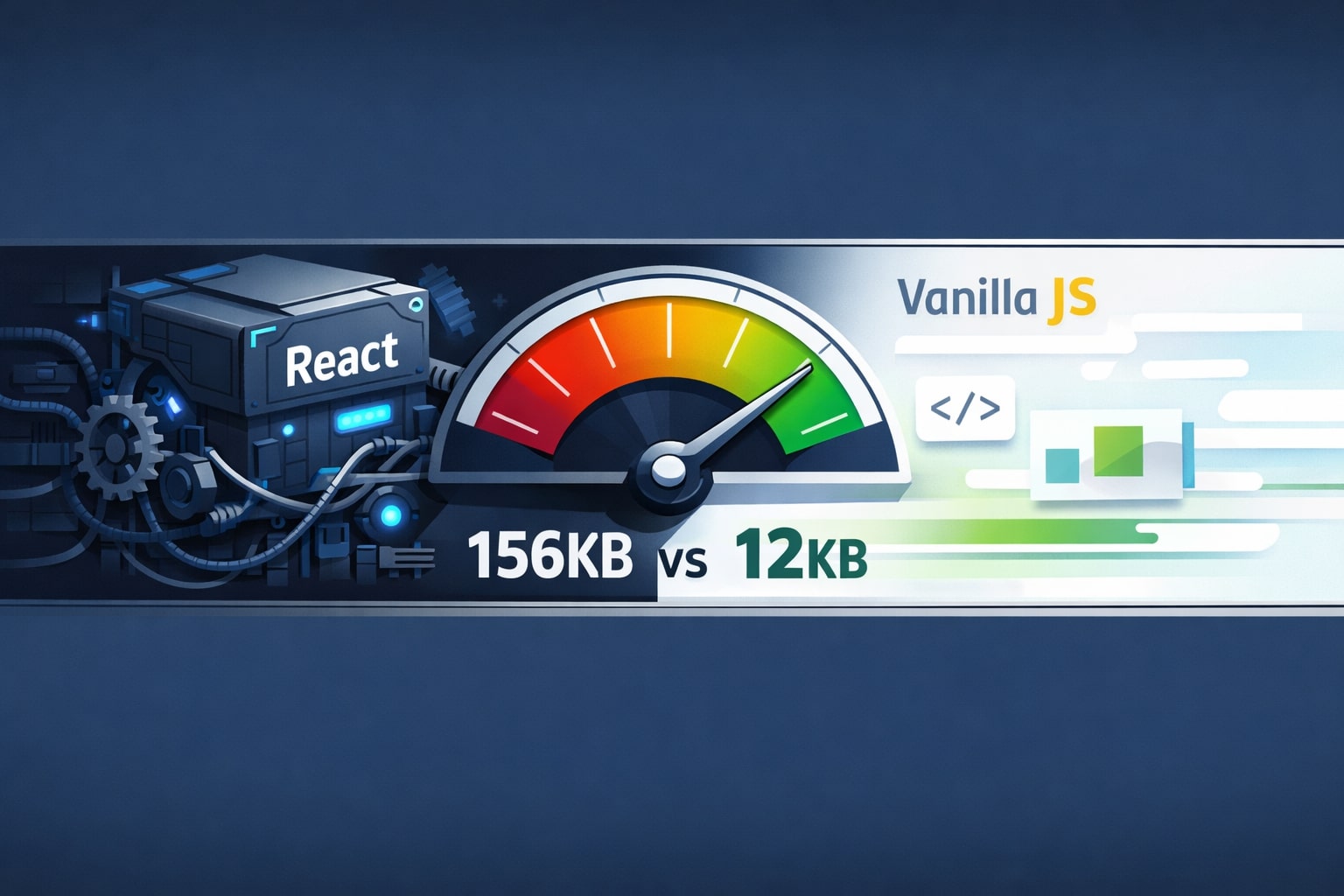
The baseline cost of React is 156KB gzipped for React plus ReactDOM. That's before writing any application code, adding routing, state management, or UI libraries. A simple todo application that could ship in 12KB as vanilla JavaScript becomes 156KB plus application code when AI scaffolds React. On 3G networks that 144KB difference translates to 3-5 seconds of additional load time before anything interactive happens.
The time to interactive metrics particularly hurt mobile users. React applications can't render until the framework downloads, parses, and initializes. Vanilla JavaScript executes progressively as it downloads. Users see and interact with vanilla applications faster than React applications delivering identical functionality. The performance gap widens on low-end Android devices common in emerging markets where CPU parsing time matters.
The memory consumption from React's Virtual DOM adds overhead that simpler approaches avoid. React maintains virtual representations of the DOM tree alongside the actual DOM, roughly doubling memory usage. On memory-constrained mobile devices, this matters. Applications consuming less memory can keep more tabs open and suffer fewer browser kills when the OS needs memory.
The AI-generated React code often includes unnecessary complexity that compounds performance problems. Models trained on complex applications with sophisticated state management reproduce those patterns even for simple projects. A todo app doesn't need Redux or Zustand, but AI might suggest them because that's what it learned from enterprise codebases. Each additional dependency adds bundle size and runtime overhead.
The build tooling complexity AI introduces creates development friction too. React projects require bundlers, transpilers, and development servers. Vanilla JavaScript works directly in browsers without build steps. For small projects or quick prototypes, this tooling overhead slows iteration velocity despite AI promising to make development faster. You wait for builds and hot module replacement when you could just refresh the browser.
The Server-Side Rendering complexity AI suggests for React applications adds infrastructure costs. Models trained on Next.js patterns recommend SSR even for applications that don't need it. Hosting SSR applications costs more than static sites. The operational complexity increases. All because AI defaulted to patterns designed for large applications when simpler alternatives work better.
When AI's Default Choice Is Wrong For Your Project
Learning to recognize when AI's React suggestion is suboptimal requires understanding what makes React actually necessary versus when it's convenient overhead. Most projects AI encounters don't need React despite AI defaulting to it automatically.
Static content with minimal interactivity never needs React. A marketing website with a few interactive elements like modals or tabs works perfectly with vanilla JavaScript. Yet ask AI to add interactivity and it scaffolds React. The framework overhead delivers zero value when vanilla JavaScript handles the requirements easily. The web standards movement specifically targets this unnecessary complexity.
Form-heavy applications with validation and data submission don't require React either. HTML forms work natively with progressive enhancement. Modern CSS handles visual feedback. JavaScript adds validation. AI sees "form with validation" and suggests React with controlled components, useForm hooks, and state management. The resulting complexity provides no user benefit while increasing bundle size and slowing page loads.
Content management systems and blogs represent another category where React adds overhead without value. Server-rendered HTML with sprinkled JavaScript for comments, search, or other interactive features performs better than client-side React. Yet AI coding assistants trained on Gatsby and Next.js blogs default to React for CMS projects even when static site generators without frameworks work better.
E-commerce product listing pages particularly suffer from AI's React bias. Users need to browse products, filter results, and add to cart. This works excellently with server-rendered HTML and vanilla JavaScript for interactivity. AI suggests React for the component model despite the performance cost hurting conversion rates on mobile devices. Amazon doesn't use React for product listings because performance matters more than developer convenience.
The decision boundary for when React actually helps versus hurts involves evaluating state complexity and component reusability. Applications with deeply nested state updated from multiple locations benefit from React's state management. Simple applications where state lives in a few variables don't. Applications with dozens of reusable components benefit from React's component model. Applications with a handful of interactive elements don't.
AI can't evaluate this tradeoff because it doesn't understand your project's actual requirements. It sees "web application" and defaults to React based on training data patterns. Your responsibility as a developer is recognizing when that default is wrong and overriding AI's suggestion with a better choice.
The Lighthouse performance scores clearly demonstrate the impact. Vanilla JavaScript applications routinely score 95-100 on Lighthouse performance. AI-generated React applications for similar functionality often score 60-80 due to bundle size and time to interactive penalties. Users don't care that React was convenient for developers. They care whether the site loads fast and responds immediately.
Breaking Free From AI-Imposed Framework Lock-In
Developers who recognize AI's React bias can actively counteract it through specific prompting strategies and tool choices. The key is being explicit about requirements rather than letting AI make architecture decisions based on training data patterns.
Prompt engineering matters enormously when using AI coding assistants. Instead of "create a todo application," specify "create a todo application using vanilla JavaScript and Web Components without frameworks." This explicit constraint forces AI to generate framework-free code. The quality varies based on how much vanilla JavaScript the model saw during training, but the specificity prevents automatic React scaffolding.
Starting prompts with framework preferences helps too. "Using vanilla JavaScript and modern CSS, implement..." tells AI your architecture choices upfront. "Without React or frameworks, build..." explicitly rules out the default. These preambles work better than hoping AI will choose appropriately based on project scope.
Providing vanilla JavaScript examples in context improves AI output quality significantly. If you paste a Web Component you wrote into the chat and ask AI to create similar components, it understands the pattern you want. The example serves as few-shot learning, teaching the model your preferred approach for this specific conversation.
Using build tools that don't assume frameworks helps prevent AI suggesting unnecessary complexity. Vite works excellently for vanilla JavaScript despite being used primarily with frameworks. Telling AI "using Vite with vanilla JavaScript" establishes you're building modern applications without frameworks, which improves the suggestions.
The Web Components specification provides a framework-agnostic target AI understands reasonably well. Asking for "a Web Component that..." leverages standards the model learned even if vanilla JavaScript training data is sparse. Web Components appear in enough documentation that models can generate acceptable implementations.
Iterative refinement often works better than expecting perfect vanilla JavaScript from first generation. Let AI scaffold React if that's what it does, then explicitly ask it to convert to vanilla JavaScript. "Rewrite this React component as a vanilla JavaScript Web Component" produces better results than hoping for vanilla from the start. The model understands React well enough to generate it correctly, then has a concrete example to translate.
Choosing AI tools matters too. Some coding assistants allow specifying technology preferences in settings or project configuration. Cursor's rules file lets you define that projects should avoid React. Windsurf's project context can include architecture decisions. Taking advantage of these features reduces fighting AI's default suggestions constantly.
Documentation-aware AI tools like those using Model Context Protocol can reference modern web standards documentation during generation. Connecting AI to MDN documentation about Web Components, Custom Elements, and Shadow DOM improves vanilla JavaScript generation quality. The model supplements its training with current authoritative documentation.
The Newer Frameworks Nobody Trained AI On
AI's React bias creates adoption barriers for newer frameworks trying to gain market share. Svelte, Solid, Qwik, and other innovative approaches face headwinds because AI tools don't know them well, creating friction for developers trying to adopt alternatives.
Svelte 5's recent release with runes demonstrates this problem. The framework offers excellent performance and developer experience, but AI coding assistants struggle generating correct Svelte 5 code because training data predates the release. Developers trying to use AI assistance with Svelte 5 find themselves correcting hallucinated APIs and outdated patterns constantly.
Solid's reactive primitives and fine-grained reactivity represent a different mental model than React. AI trained primarily on React patterns generates Solid code that looks like React with different syntax rather than idiomatic Solid leveraging the framework's strengths. This produces suboptimal code that doesn't benefit from Solid's performance advantages.
Qwik's resumability and edge-first architecture are barely represented in training data. AI can't generate proper Qwik applications because it hasn't seen enough examples. Developers choosing Qwik for its performance benefits find AI tools actively harmful, generating patterns that break resumability or defeat the framework's optimizations.
The documentation quality gap becomes critical for these newer frameworks. React's documentation advantage means AI has better source material for learning React patterns. Newer frameworks with less extensive documentation get learned less effectively during training. Until these frameworks generate substantial documentation, tutorials, and community content, AI will continue struggling.
The chicken-and-egg problem creates frustrating dynamics. Developers might try Svelte or Solid because of performance benefits or better developer experience. They expect AI coding assistants to help like they do with React. When AI struggles, developers blame the framework rather than recognizing the tool limitation. This discourages adoption and perpetuates React's dominance.
Framework authors recognize this challenge and some are addressing it directly. Providing high-quality example repositories, comprehensive documentation, and AI-specific guidance helps models eventually learn through retraining. Some frameworks create dedicated AI assistants fine-tuned on their specific patterns, though this requires resources smaller projects lack.
The Model Context Protocol offers a potential solution by letting frameworks provide documentation dynamically during AI interactions. An MCP server serving current Svelte or Solid docs means AI can reference up-to-date information even if training data is outdated. This helps but doesn't fully solve the pattern recognition advantage React enjoys from massive training data.
Why This Actually Matters For Your Career
Understanding AI's React bias affects career decisions more than it might seem. The skill market, project architecture choices, and long-term technology bets all connect to how AI tools shape framework adoption and developer behavior.
Developers learning primarily through AI-assisted coding risk never understanding why frameworks exist or when simpler approaches work better. If AI always suggests React, developers accept React as the default without evaluating alternatives. This creates a generation of programmers who know React patterns but don't understand vanilla JavaScript well enough to recognize when frameworks are unnecessary overhead.
The job market implications cut both ways. React skills remain in high demand because of ecosystem momentum and AI amplification. Developers comfortable with React find abundant opportunities. However, developers who understand vanilla JavaScript, Web Components, and when to avoid frameworks become increasingly valuable as performance-sensitive companies seek alternatives to framework bloat.
The TypeScript integration with AI tools particularly matters for React developers. AI generates significantly better React code with TypeScript because types provide context models use for more accurate suggestions. React developers who learn TypeScript get better AI assistance than those using vanilla JavaScript, reinforcing React with TypeScript as the AI-optimized stack.
The framework evaluation skill becomes critical as AI makes framework choice less visible. When developers ask AI to build features and React appears automatically, they need judgment to recognize whether that's the right choice. Senior developers who can evaluate tradeoffs between frameworks and vanilla approaches rather than accepting AI defaults demonstrate architectural maturity that companies value.
The performance optimization skills around avoiding unnecessary frameworks will increase in value as companies recognize AI-generated bloat. Organizations paying attention to Core Web Vitals, mobile performance, and user experience need developers who can build performant applications regardless of what AI suggests. This creates opportunities for developers who master vanilla JavaScript and web standards.
The framework lock-in risk AI creates affects long-term project maintenance. Applications built because AI defaulted to React face migration costs if requirements change or better alternatives emerge. Developers who made conscious architecture decisions can defend them. Those who accepted AI defaults without evaluation create technical debt they might not recognize until maintenance costs become painful.
Making Better Architecture Decisions Despite AI Defaults
Practical strategies exist for using AI productivity benefits while avoiding its React bias. The key is maintaining architectural decision authority rather than outsourcing technology choices to training data patterns.
Establish project architecture before engaging AI tools. Decide whether frameworks are necessary based on actual requirements like state complexity, component reusability needs, and team size. Document this decision and use it to constrain AI suggestions. Telling AI "this is a vanilla JavaScript project" upfront prevents framework scaffolding.
Create project templates that embody your architecture decisions. If you prefer vanilla JavaScript for certain project types, maintain templates AI can reference. Asking AI to generate code following your template structure produces better results than hoping it will choose appropriately.
Review AI-generated architecture critically before accepting it. When AI suggests React, ask yourself whether the project actually needs a framework. Can vanilla JavaScript handle the requirements? Would Web Components provide enough structure without framework overhead? Would a lighter framework like Preact or Solid deliver React-like benefits with better performance?
Use AI for implementation within frameworks you've already chosen rather than letting it choose frameworks. If you decide React is appropriate, great. Use AI to generate React components. But make that decision consciously rather than accepting AI's default. If you choose vanilla JavaScript, explicitly tell AI and use it to generate vanilla code.
Measure the cost of AI's suggestions. Run Lighthouse performance audits on AI-generated applications. Check bundle sizes. Measure time to interactive. When AI's React suggestion creates performance problems, that's data supporting simpler approaches. Use metrics to validate or reject AI architecture choices.
Learn framework-agnostic web development skills. Understanding how browsers work, what Web Components provide, and how vanilla JavaScript handles state and events makes you less dependent on AI's framework choices. These fundamentals let you evaluate whether AI's suggestions make sense for your specific context.
Contribute to training future AI models by writing and sharing vanilla JavaScript and Web Component examples. Open source projects using modern vanilla JavaScript patterns help balance the training data React dominance. Over time, better representation means AI suggestions become less biased.
The Longer-Term Evolution Nobody's Predicting
AI's React bias will diminish over time as models retrain on more recent data capturing framework diversity. But the timeline is measured in years, and the intermediate period creates interesting dynamics worth understanding.
Model vendors recognize framework bias as a problem worth solving. Future training runs will intentionally sample diverse frameworks more evenly rather than letting React's statistical dominance drive all patterns. This means model updates in 2026 and 2027 should generate better Svelte, Solid, Vue, and vanilla JavaScript code.
The Model Context Protocol adoption accelerates this improvement without waiting for retraining. Frameworks providing MCP servers with current documentation mean AI can reference up-to-date information during conversations. This helps with new framework versions and emerging patterns that aren't yet in training data.
The web standards movement gaining momentum means more vanilla JavaScript and Web Component examples enter the training corpus. As developers increasingly question framework necessity and share standards-based implementations, models learn these patterns. The bias diminishes as the training data diversifies.
Framework authors will increasingly provide AI-specific resources recognizing AI's importance in adoption. Official AI assistants fine-tuned on specific frameworks might become common. Vue providing a Vue-specialized coding assistant, Svelte offering Svelte-optimized AI tools, creates ecosystem diversity that counteracts React's general-purpose AI advantages.
The performance costs of AI-generated framework overhead will drive tooling improvements. Build tools might automatically detect when AI scaffolded unnecessary frameworks and suggest lighter alternatives. Linters could flag "this application doesn't need React" based on analyzing actual state and component complexity.
The React ecosystem itself might evolve toward lighter-weight options as AI-induced bloat becomes recognized. Preact demonstrates that React's API works with fraction of the bundle size. More developers might choose Preact specifically because AI generates React-compatible code that Preact runs with better performance.
The career advantage will shift toward developers who can work effectively across frameworks and vanilla JavaScript. As models improve at generating any framework, knowing React specifically becomes less differentiating. Understanding when to use which approach and evaluating AI suggestions critically becomes the valuable skill.
The web platform standards will continue evolving to reduce framework necessity. Features like Declarative Shadow DOM, CSS Container Queries, and View Transitions API eliminate categories of problems frameworks solved. As the platform improves, the gap between vanilla JavaScript and frameworks narrows, making framework choice less critical and AI's bias less impactful.
The ultimate outcome likely involves AI becoming framework-agnostic while helping developers choose appropriate tools. Rather than defaulting to React, future AI might analyze project requirements and recommend React for complex applications, Astro for content sites, and vanilla JavaScript for simple interactions. This requires models understanding not just how to generate React but why React exists and when alternatives work better.
We're not there yet. In 2025 and early 2026, AI has React bias and developers must actively counteract it. Understanding this bias, recognizing when it creates problems, and knowing how to override AI defaults distinguishes developers who use AI as a tool from those who let AI make their decisions. The web platform offers better approaches for many projects than AI's React default. Your job is recognizing when to reject that default and build better solutions despite what training data patterns taught AI to suggest.
📧 Subscribe to JS Pulse
The JavaScript job market in one email: real numbers from 600+ job listings, 5 jobs worth applying to, and what actually changed. Join 9,000+ developers.
Share this article